Understanding skin phototypes helps you better protect yourself from solar radiation and choose the right care for your face and body. Knowing your phototype provides key information about the amount of melanin in your skin, the likelihood of suffering sunburns, and how your skin will react to treatments such as laser hair removal or various dermatological procedures.
What are skin phototypes
Skin phototypes are a classification based on the skin's response to sun exposure, as well as physical characteristics such as hair and eye color and the tendency to burn or tan.
This classification allows for an estimation of skin sensitivity to ultraviolet rays (UVA and UVB) and provides guidance on appropriate protection, the prevention of spots, and long-term risks, such as skin cancer.
Classification of skin phototypes according to Fitzpatrick
The Fitzpatrick scale divides phototypes into six categories that describe how skin reacts to solar radiation: from skin that always burns and never tans, to skin that rarely burns and tans easily.
This classification of skin phototypes is a common reference in dermatology and aesthetics for planning care, treatments, and solar protection levels.
Table of skin phototypes according to Fitzpatrick
|
Phototype |
Skin color |
Reaction to the sun |
Sunburn risk |
|
I |
Very fair |
Always burns, never tans |
Very high |
|
II |
Fair |
Burns easily, minimal tan |
High |
|
III |
Medium |
Burns occasionally, gradual tan |
Medium |
|
IV |
Olive/Brown |
Rarely burns, tans easily |
Low |
|
V |
Dark |
Very rarely burns |
Very low |
|
VI |
Very dark |
Practically never burns |
Low, but existing |
Knowing skin phototypes allows you to better identify your risk regarding the effects of solar radiation and to adopt protective habits that help minimize damage, such as the correct use of sunscreen, protective clothing, and seeking shade during hours of high solar intensity.

Characteristics of each skin phototype
Phototype I: Very fair and sensitive skin
Phototype I corresponds to very fair skin that almost always burns with sun exposure and does not tan. It is common to have light eyes, blonde or red hair, and freckles. This skin has a low amount of melanin, which increases the risk of sunburns and long-term damage, including skin cancer. It requires high daily protection and strict preventive habits.
Phototype II: Fair and sensitive skin
Phototype II features fair skin that burns easily and achieves a light tan. Eyes and hair are usually light or light brown. Consistent use of broad-spectrum sunscreen and reapplication during outdoor activities is essential to reduce sunburns and spots.
Phototype III: Medium and sensitive skin
Phototype III describes medium-toned skin that burns occasionally and tans gradually. Brown hair and brown eyes are typical. Although it tolerates sunlight better than phototypes I and II, it remains vulnerable to accumulated sun damage and the appearance of spots.
Phototype IV: Olive/brown and moderately sensitive skin
Phototype IV corresponds to brown skin that rarely burns and tans easily. The higher presence of melanin reduces the risk of sunburn, but does not eliminate it. It is important to consider the risk of hyperpigmentation, especially after aesthetic procedures or dermatological treatments.
Phototype V: Dark and resistant skin
Phototype V includes dark skin that almost never burns and tans easily. The high concentration of melanin offers natural protection against ultraviolet rays, although prolonged exposure can cause accumulated damage, changes in texture, or spots.
Phototype VI: Very dark and resistant skin
Phototype VI groups very dark skin that rarely burns. Although solar redness is infrequent, radiation still contributes to skin aging and hyperpigmentation, so sun protection remains necessary.

How to identify my skin phototype
To identify your phototype, observe how your skin reacts to the sun: whether it burns easily, whether it tans quickly, eye and hair color, and the presence of freckles or spots. A more precise evaluation can be performed by a dermatologist, also considering your history of sunburns and response to treatments such as laser hair removal.
Influence of skin phototypes on skin cancer risk
Phototypes with less melanin (I and II) have a higher risk of injuries from ultraviolet radiation and of developing skin cancer. However, all phototypes can be affected if exposure is not controlled. Prevention and regular dermatological check-ups are key in all cases.
Care and recommendations according to your skin phototype
Skin care combines external and internal protection: daily use of sunscreen, avoiding hours of peak radiation, covering skin with appropriate clothing, and choosing products compatible with your skin type.
Appropriate sun protection according to skin phototype
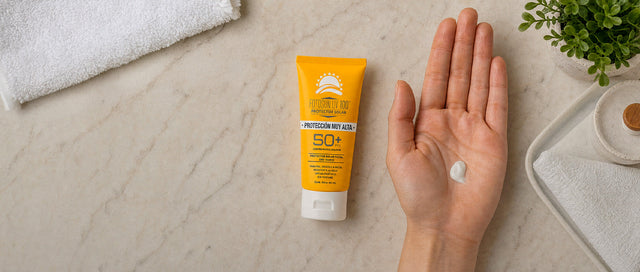
A broad-spectrum sunscreen against UVA and UVB rays is always recommended. Phototypes I and II require high SPF and frequent reapplication. Phototypes III and IV must maintain daily protection, while phototypes V and VI should not rely solely on natural protection. Products such as Fluid Protect Luz Azul (50 ml), Solar Brush (4 g), and Adaptive Color (60 ml) allow protection to be adapted to different routines.
Protect your skin with Fotosun UV sunscreens
Choosing a sunscreen according to your phototype and lifestyle improves protection and the user experience. Fotosun UV 100 offers options designed for families looking for safety and convenience. For children, sunscreen for kids is an alternative; for teenagers and adults, there are options for powder sunscreen, travel-size sunscreen, facial sunscreen, tinted sunscreen, sunscreen for body and face, liquid sunscreen.
Discover more Daclaf products, such as vitamin c sachets, fiber supplements, amino acid supplement, probiotic capsules, advanced probiotics, probiotics for women, 10 billion probiotics, 2 billion probiotics, nasal spray, lip balms, sunscreens and more.

Frequently asked questions
Do skin phototypes influence skin aging?
Yes. Fair phototypes tend to show signs of aging sooner if not properly protected, although all skin types can develop accumulated sun damage.
Can I have a different phototype on different areas of my body?
It is possible for some areas to look lighter or darker due to sun exposure, but the overall skin phototype remains the same.